


An All-Terrain Suspension Kart is not simply a go-kart with knobby tires. Its independent front suspension, eight shock absorbers, long-travel steering, and electric drivetrain are engineered around one practical reality: outdoor ground changes constantly. This article explains how the vehicle’s chassis and suspension layout respond to grass, gravel, dirt, mud, and compacted trails, what the specifications reveal about real-world capability, and how owners can maintain consistent performance across mixed surfaces. The focus stays on mechanical behavior and terrain adaptation rather than any commercial promise.
Table of Contents
- 1. What Terrain Does This Vehicle Actually Target?
- 2. How Does Independent Front Suspension Change Uneven Ground?
- 3. Why Do Eight Shock Absorbers Matter on a Recreational Kart?
- 4. What Do the Tires and Steering Geometry Reveal?
- 5. How Does Electric Power Behave Across Mixed Surfaces?
- 6. What Specifications Matter for Terrain Use?
- 7. How Should the Kart Be Maintained After Dirt and Mud?
- 8. Frequently Asked Questions
1. What Terrain Does This Vehicle Actually Target?
Outdoor recreation rarely happens on a single, consistent surface. A private trail may begin on compacted dirt, transition to gravel near a gate, soften into grass along a fence line, and end in shallow mud after rain. A kart designed for a paved circuit has little reason to anticipate any of that. Its chassis sits low, its suspension travel is minimal, and its steering geometry is tuned for smooth inputs. The All-Terrain Suspension Kart approaches the problem from the opposite direction: it assumes the surface will change during the ride.
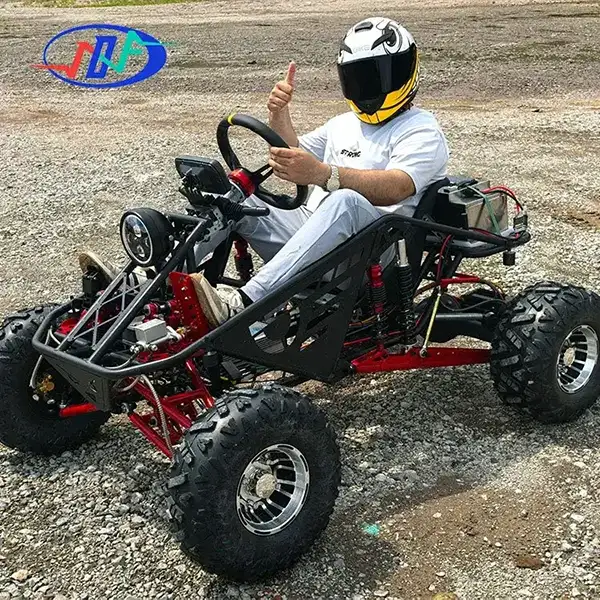
The vehicle is built around recreational and commercial outdoor use rather than competition. That distinction matters because the engineering priorities shift. A racing kart benefits from a stiff frame and limited suspension movement to preserve precise load transfer. A recreational off-road kart benefits from compliance: the ability to let individual wheels absorb irregularities without transferring every impact into the frame or the driver. The design choices described on this model—independent front suspension, four front and four rear shock absorbers, long-travel steering, and large off-road tires—all serve that compliance objective.
Grass and dirt represent the most accessible starting point. On these surfaces, the tire tread needs to evacuate loose material and maintain contact without requiring excessive wheel speed. Gravel and compacted hard trails introduce a different demand: small, frequent impacts that a stiff chassis would transmit directly upward. Mud and uneven ground add variable traction and inconsistent resistance from one wheel to the next. The vehicle does not claim to conquer bottomless mud or extreme rock crawling, and that honesty is useful. It is engineered for suitable outdoor surfaces where the ground changes in ordinary, predictable ways.
2. How Does Independent Front Suspension Change Uneven Ground?
The front axle is where a driver feels terrain first. When a single front wheel strikes a root, a stone, or a rut, the question is whether that impact stays local or travels through the chassis. A solid front axle connects both wheels mechanically; movement on one side inevitably influences the other. Independent front suspension separates the two sides, allowing each wheel to respond to the surface beneath it without forcing the opposite wheel to follow the same path. This is not a marginal difference on uneven ground.
Industry comparisons of independent versus solid-axle layouts consistently point to the same conclusion: independent suspension provides better bump absorption and steering feel on irregular surfaces because each wheel can move on its own[reference:0]. In heavier off-road applications, independent front suspension has been associated with more predictable steering and improved ride quality over broken ground, partly because suspension travel can be designed more generously without forcing both wheels to move together[reference:1]. The principle scales down to recreational karts: the front wheels need to track the ground independently when the ground is not flat.
The practical result is a front end that feels less unsettled when one side drops into a shallow depression or climbs over a gravel ridge. Steering remains more consistent because the driver is not fighting a front axle that wants to pivot around a single shared axis. On a trail where the surface alternates between packed dirt and loose stone, that consistency reduces the small corrections a driver would otherwise make continuously.
3. Why Do Eight Shock Absorbers Matter on a Recreational Kart?
Shock absorbers convert motion into heat. When a wheel encounters a bump, the spring compresses and stores energy; the shock absorber controls how quickly that energy is released and how much oscillation follows. Without adequate damping, a vehicle continues to bounce after the initial impact, and tire contact becomes inconsistent. With appropriate damping, the wheel returns to the ground quickly and the chassis remains more stable.
This model uses four front and four rear shock absorbers, eight in total. That count is unusual in the recreational kart segment and reflects an emphasis on compliance rather than track stiffness. The All-Terrain Suspension Kart is tuned for leisure and outdoor use, where softer spring and damper settings generally provide better comfort than racing-level settings[reference:2]. A softer tune allows the suspension to absorb small irregularities that would otherwise be transmitted as vibration through the frame, seat, and steering wheel.
More dampers do not automatically mean better performance. Placement, valving, spring rate, and the relationship between front and rear damping all matter. But a higher damper count gives the chassis designer more control points to manage load transfer and wheel motion across a longer wheelbase. On a vehicle intended to cross grass, gravel, and compacted trail in the same outing, that additional control helps keep the tires loaded and the frame isolated from repeated small impacts.
Rear suspension deserves separate attention. On rough terrain, a rear axle that cannot absorb impacts forces the frame to endure them directly. Suspension at the rear helps keep the tires loaded and driving, protects the frame from fatigue cracks, and improves comfort on rough ground[reference:3]. The fixed rear bracket on this model should be understood as a layout choice rather than a claim of independent rear suspension; the eight-shock arrangement is the relevant context for how the vehicle manages rear impacts.
4. What Do the Tires and Steering Geometry Reveal?
Tire size and tread pattern determine how the vehicle meets the ground. This kart runs 19 × 7.00-8 front tires and 18 × 9.50-8 rear tires in an off-road pattern. The front tire is narrower than the rear, which supports steering precision on loose surfaces; the rear tire is wider, providing a larger contact patch for traction under electric torque. The large overall diameter relative to a standard kart tire increases the ability to roll over small obstacles rather than stalling against them.
Tread design matters as much as size. An off-road pattern with deep, open blocks can evacuate loose dirt and gravel and maintain grip on grass. The limitation appears in very deep mud or extremely soft ground, where any tire can lose traction if the surface cannot support the vehicle’s weight. The manufacturer acknowledges this boundary directly, which is more useful than an exaggerated claim of unstoppable performance.
Steering geometry completes the front-end picture. Long-travel steering provides more suspension movement before the steering linkage reaches its limits, which helps preserve control when the front wheels articulate over uneven ground. A quick-release steering wheel adds convenience for entry and exit, but the long-travel system is the terrain-relevant component: it allows the front wheels to follow the ground while the steering remains connected and predictable.
- Front tire: 19 × 7.00-8 — narrower profile for steering response and loose-surface contact.
- Rear tire: 18 × 9.50-8 — wider contact patch for traction under load.
- Steering: Long-travel system — maintains linkage control as the front suspension moves.
- Wheelbase context: Front and rear tire diameters differ intentionally to balance steering and drive grip.
5. How Does Electric Power Behave Across Mixed Surfaces?
Electric drivetrains deliver torque differently from combustion engines. A 72V 3000W brushless motor paired with a gearbox transmission provides responsive power without the need to build engine speed before torque arrives. On a surface that changes from hard-packed dirt to loose gravel, that immediacy can be helpful, but it also demands control. The controller and speed modes are therefore as relevant to terrain behavior as the motor itself.
Low, Medium, and High speed modes give the driver a way to match power delivery to the surface. Low is appropriate for tight private trails, muddy sections, or areas where traction is uncertain. Medium suits mixed grass and gravel where moderate momentum helps maintain contact. High is intended for open, suitable ground where the driver has clear visibility and the surface supports higher speed. Reverse adds practical maneuverability in confined spaces, but it is not a terrain capability in itself.
The FarDriver 72450 controller manages power delivery and includes brake cut-off and anti-rollback or hill-hold functions. On uneven ground, brake cut-off prevents throttle and braking from conflicting, while hill-hold reduces the tendency to roll backward when the vehicle stops on an incline. These are small functions individually, but they contribute to control on the kind of sloped, mixed-surface terrain that recreational riders encounter.
The 72V 40Ah battery and approximately 2.7-hour charging time define the usage rhythm rather than the terrain capability. A rider planning a long trail session should understand that the vehicle is designed for recreational outings, not all-day expedition use. That framing keeps expectations aligned with the engineering.
6. What Specifications Matter for Terrain Use?
Specifications are only useful when read in context. The table below groups the figures that most directly influence how the vehicle behaves when the ground is not uniform. Performance claims such as top speed are less important here than dimensions, suspension layout, tire size, and control features.
| Terrain-Relevant Item | Specification | Why It Matters |
|---|---|---|
| Front suspension | Independent suspension | Allows each front wheel to respond separately to bumps and ruts. |
| Shock absorbers | 4 front + 4 rear, 8 total | Provides multiple damping control points across the chassis. |
| Steering | Long-travel steering system | Maintains steering linkage control as front suspension articulates. |
| Front tires | 19 × 7.00-8 off-road | Narrower front profile supports steering on loose ground. |
| Rear tires | 18 × 9.50-8 off-road | Wider contact patch improves drive traction. |
| Speed modes | Low / Medium / High + Reverse | Allows power delivery to be matched to surface conditions. |
| Brakes | Front and rear dual hydraulic, 4 total | Balanced stopping control on mixed surfaces. |
| Brake function | Cut-off + anti-rollback / hill-hold | Reduces control conflicts and rollback on inclines. |
| Max load | 440 lb / 200 kg | Defines the load envelope for suspension tuning. |
| Vehicle weight | 330 lb / 150 kg | Influences power-to-weight and braking distance. |
A second set of figures matters for fit and daily use rather than terrain response. Recommended rider height is 4.59–6.56 ft, foot pedal to seat base space is 90 cm, and height to the steering wheel is 97 cm. These dimensions determine whether a driver can maintain a stable seating position while the vehicle moves over uneven ground. A driver who is stretched to reach the pedals or crowded against the wheel will have less control when the surface becomes rough.
7. How Should the Kart Be Maintained After Dirt and Mud?
Terrain capability degrades quietly if maintenance is neglected. Mud and dirt accumulate around the frame, suspension joints, wheel hubs, and steering components. Left in place, that buildup can retain moisture, accelerate wear, and obscure early signs of damage. The maintenance routine for this type of vehicle is not complicated, but it needs to be consistent, especially after rides on wet or dusty ground.
Cleaning should begin before mud dries. A low-pressure garden hose is appropriate for removing loose material; high-pressure washing can force water into bearings, electrical connectors, and the controller housing[reference:4]. A mild detergent and a soft brush are sufficient for the frame and suspension components. Areas around the battery compartment, motor controller, brake cables, and switches deserve particular care because water intrusion in those locations creates electrical and safety problems that are far more serious than cosmetic dirt.
After cleaning, a visual inspection is more valuable than a lengthy checklist. Look at the tires for cuts or embedded debris, the suspension for leaking dampers or loose mounts, the steering for play or binding, and the brakes for contamination. Dirt on brake components can reduce friction consistency; mud packed around the hubs can affect wheel rotation. These are ordinary inspection points, but they become more important when the vehicle is used repeatedly on gravel, mud, and rough trails.
The All-Terrain Suspension Kart is supported with spare parts and technical guidance from Jindifan, which matters for long-term ownership. A vehicle designed for mixed outdoor surfaces will consume consumable components—tires, brake pads, bearings, and damper seals—at a rate influenced by terrain. Access to correct replacement parts preserves the suspension behavior that defines the vehicle in the first place.
8. Frequently Asked Questions
Does independent front suspension make this kart suitable for rock crawling?
No. Independent front suspension improves wheel response on uneven ground, but this vehicle is designed for recreational outdoor surfaces such as grass, dirt, gravel, compacted trails, and suitable mud. Rock crawling demands different ground clearance, tire construction, and drivetrain characteristics. The kart is capable within its intended terrain envelope, not beyond it.
Why does the kart use eight shock absorbers instead of four?
Eight dampers provide more control points for managing wheel motion and chassis movement across a longer wheelbase. On mixed outdoor surfaces, that additional damping helps isolate the frame from repeated small impacts and keeps the tires more consistently loaded. The benefit depends on correct valving and spring matching, not on the count alone.
Can the vehicle cross mud and uneven ground?
It can handle suitable muddy and uneven surfaces, but very deep mud or extremely soft ground can reduce traction regardless of tire or suspension design. The limitation is surface support, not vehicle capability alone. Riders should assess ground conditions before entering sections where the vehicle might become stuck or lose control.
What is the purpose of the long-travel steering system?
Long-travel steering allows the front wheels to articulate over uneven ground while the steering linkage remains within its operating range. Without adequate travel, suspension movement can bind or limit steering, reducing control exactly when the surface demands more driver input. It is a supporting system for the independent front suspension, not a standalone feature.
Do the speed modes affect terrain performance?
Yes. Low speed mode is useful on slippery, muddy, or tight terrain where smooth power delivery matters. Medium suits mixed grass and gravel where moderate momentum helps maintain tire contact. High is appropriate for open, suitable ground with clear visibility. Matching speed to surface is one of the simplest ways to preserve control and reduce drivetrain stress.
How often should the kart be cleaned after off-road use?
After every ride on dirt, gravel, mud, or dusty ground. Mud should be removed before it dries, using low-pressure water and a mild detergent. Pay attention to the suspension, hubs, steering components, and the area around the battery and controller. A brief inspection after cleaning is more effective than a deep cleaning performed infrequently.
The defining quality of this vehicle is not a single specification but the relationship between its systems. Independent front suspension lets the front wheels follow uneven ground. Eight shock absorbers manage the resulting motion. Long-travel steering preserves control as the suspension works. Off-road tires maintain contact across loose and compacted surfaces. Electric power with selectable speed modes allows the driver to match delivery to conditions. None of these features is unique in isolation, but their combination is what allows an All-Terrain Suspension Kart to remain composed when the ground changes from grass to gravel to dirt within a single outing.
Planning a mixed-surface recreational setup?
Discuss terrain conditions, rider fit, and configuration options with the team before finalizing a vehicle specification. Clear requirements lead to better suspension tuning, accessory selection, and long-term parts support.
Contact Us


